Thursday, August 21, 2008

3 Texas polygamists indicted by grand jury

A Texas grand jury indicted three more members of a polygamist sect that was raided in April, a Schleicher County official told CNN on Thursday.
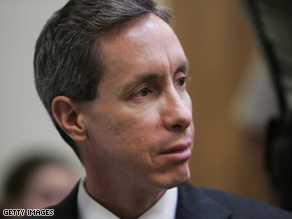
Warren Jeffs and four followers were indicted in Texas in July on child sex abuse charges.

Warren Jeffs and four followers were indicted in Texas in July on child sex abuse charges.

"We have three indictments on three people," said Peggy Williams, the county clerk. "There will be no more information released until the three individuals have been served. We are not releasing names or charges at this time."

Five Texas members of the Fundamentalist Church of Jesus Christ of Latter Day Saints (FLDS), along with the group's leader, Warren Jeffs, were indicted in July in Texas on charges relating to accusations of sexual abuse of children.

Jeffs was charged with the sexual assault of a child, which is considered a first-degree felony. If convicted, he would face a maximum penalty of five to 99 years or life in prison, as well as a fine of up to $10,000.

Four of Jeffs' followers were charged with one count each of sexually assaulting girls under the age of 17, and one of those four also faces a bigamy charge. A fifth follower is charged with three counts of failure to report child abuse.

Jeffs, 52, is the leader and "prophet" of the estimated 10,000-member FLDS, an offshoot of the mainstream Mormon church. The FLDS openly practices polygamy at its Yearning for Zion (YFZ) Ranch outside Eldorado, Texas, and in two towns straddling the Utah-Arizona state line -- Hildale, Utah, and Colorado City, Arizona.

Critics of the FLDS say it forces girls as young as 13 to marry men. It is not affiliated with the mainstream Mormon church, which renounced polygamy more than a century ago. FLDS members maintain that no sexual abuse of children takes place.

Texas authorities raided the ranch in April, seizing more than 400 children who were later returned to their families after the Texas Supreme Court ruled the state had no right to remove the children and lacked evidence to show they faced imminent danger of abuse.

Last November, Jeffs was sentenced to two consecutive terms of five years to life in Utah after being convicted on two charges of being an accomplice to rape in connection with a marriage he performed in 2001 between a 14-year-old girl and her 19-year-old cousin.

He is being held in the Mohave County Jail in Kingman, Arizona, awaiting trial on four charges of being an accomplice to sexual conduct with a minor.

Jeffs has been in custody since August 2006, when he was arrested during a routine traffic stop after spending several months on the FBI's 10 most-wanted fugitives list.

Wednesday, August 20, 2008

Boy plunges ten stories to his death

Jacob Neuman (image courtesy New York Daily News)
Jacob Neuman (image courtesy New York Daily

A five-year-old New York City boy plunged nearly ten stories to his death after he tried to escape from a trapped elevator.

Jacob Neuman and his eight-year-old bother Israel went into the lift just before 9 am on their way to school when it suddenly became stuck between the 10th and 11th floors.

The Brooklyn boys began pushing the elevator buttons when one of the doors partially opened.

Jacob Neuman squeezed through the door and tried to jump to the tenth floor, but slipped and fell down the shaft while his older brother watched helplessly.

Israel Neuman was hysterical according to police and wasn't rescued until a neighbour heard screaming.

"I heard him screaming and crying," Jose Estrada told the New York Daily News.

"He was saying, 'Help! Help!' He was screaming 'My brother! My brother!"

Neighbours told the New York Daily News that the two brothers were inseparable and that Jacob was a 'bright student with a big smile'.

It was later revealed by city officials that the elevator that claimed the child’s life had failed its most recent inspection and malfunctioned five times since February.

Tempers flare at Boobs on Bikes parade


Tempers flared as marchers raising awareness of links between pornography and sexual violence faced off with people watching Boobs on Bikes in Auckland.

"It makes objects out of women - it degrades them and we're sick of people like Steve Crow trampling over the values of our country," said one protester.

The protest organised by Auckland Women's Centre and Stop Demand Foundation began about half an hour before the Boobs on Bikes parade and had about forty protesters.

Among those in the demonstration were four councillors from Auckland City Council, including Cathy Casey whose legal bid to stop the parade was rejected yesterday.

Ms Casey had threatened to lie in front of the parade to stop it but today she did not go through with her threat.

Stop Demand founder Denise Ritchie said the demonstrators had been well received, apart from several sections of Queen St heckling the group.

"It was an excellent opportunity to get our message out there.

"In a perverse way Steve Crow has provided us with a wonderful platform."

Spectators watching the topless women on motorcycles heading down Queen Street booed the second protest, yelling at the demonstrators "You can't stop it!"

Objects were also thrown at members of the protest; one participant reported being hit with an L&P bottle.

Other spectators tried to grab a banner off two people protesting against the parade.

Boobs on Bikes organiser Steve Crow said it was great to see people protesting.

"It's nice to see a few protesters exercising their right to free speech," he said.

The only other tension during the controversial hour long parade was when eggs were thrown from a building on lower Queen St at Mr Crow, with one egg narrowly missing one of four policemen.

Mr Crow, in a black Bentley convertible, led the parade and had instructed the topless women beforehand to keep the jiggling to a minimum and to not do anything that would be deemed offensive.

The parade featured about 30 women baring their breasts to crowds lining the footpaths.

Thousands of people left their office buildings to witness the spectacle. A strong police presence was also evident.

The huge crowd, at times lined six deep, cheered and and snapped the topless women on cellphones and cameras.

There were also few hecklers among the crowd.

One man shouted at Mr Crow, asking him if he was a pervert.

Mr Crow replied he was not a pervert, he was comfortable with who he was and what he did, and it was the man on the sidewalk who was the pervert.

Auckland police were unable to give a crowd estimate but spokeswoman said an officer Noreen Hegarty quoted the officer in charge as saying "plenty more people than last year."

She said there were no arrests and the crowd was orderly.

While the crowd was predominantly male from all age groups and professions, many women also watched the parade.

One woman, in her 50s, who did not want to be named said she was a tourist from Canada.

"We've got nothing like this at home."

The woman said she was taking photos of the parade to show friends and family in Canada because "no one will believe me".

Five policemen at the front of the parade at times struggled to contain the crowd which spilled on to the road from the sidewalks.

Virtually every possible viewing space was taken up with construction workers watching from building sites and office workers looking out of windows.

Dave from Auckland said it was the first time he'd been to the event.

"I've never been to it before. It's a good event for Auckland city, a bit of money will be spent here today because of it."

Mark from Auckland was also a first time attendee.

"It was good, never seen it before. I liked the boobs best, there wasn't enough of them though! It shouldn't be criticised, there's no harm in it as long as there are no children around."

A house painter who decided to take the day off to experience the parade said it was awesome.

"I wish it was only halfway through. I'm not disappointed, we'll wait for it to come back around the street."

Some spectators said the parade could have been a little larger.

"I was expecting it to be a bit bigger. It's got way too much publicity for what it is. I wanted to see what all the fuss was about. I thought there would have been heaps more too it." Auckland resident Greg said.

Kevin from Auckland echoed the sentiment.

"It was pretty small though, I was expecting it to be a bit bigger. The bikes were pretty good actually, maybe even better than the women," he said.

Heptathlete tests positive to anabolic steroids

Ukraine Olympic silver medallist Lyudmila Blonska has tested positive to anabolic steroids at the Beijing Olympic Games and faces a life time ban from sport.

Blonksa, 30, has tested positive to steroids after picking up the silver medal in the heptathlon, held on August 16.

It is her second positive drugs test, having tested positive to a common steroid stanozolol back in 2003.

Under the World Anti Doping Agency rules, a second offence for steroids brings a mandatory life sanction.

Sources have confirmed to the Herald/Age that the IOC disciplinary committee will meet tomorrow and is likely to strip Blonksa of her Beijing medal and reallocate the heptathlon minor medals.

That will mean US bronze medallist Hyleas Foutain will be promoted to the silver medal and fourth placed Russian Tatiana Chernova to the bronze medal. Blonska's team mate Natalya Dobryaska won the gold. Australia's Kylie Wheeler will move up to finish 10th.

Blonska was also due to compete in the long jump final after qualifying second with a leap of 6.76m. Her spot may now be taken by another Ukrainian Viktoria Rybalko.

This is the fifth drugs test result from the Beijing Olympic Games. Others to have been caught are Spanish cyclist Maria Isabella Moreno. who tested positive to erythropoietin, North Korean shooter Kim Jong Sun (beta blockers), Vietnamese gymnast Do Thi Ngan Thuong (stimulants) and Greek sprinter Fani Halkia (methyltrienolone).

Red Cross gains access to Georgia war zone

NATO and Russia remained at loggerheads over the crisis in Georgia Wednesday, as the Red Cross plans to send aid workers to South Ossetia for the first time.
A convoy of Russian armored vehicles pictured outside Gori Tuesday.

A convoy of Russian armored vehicles pictured outside Gori Tuesday.

Jakob Kellenberger, president of the International Committee of the Red Cross, speaking at the organization's headquarters in Geneva, said it would send workers to Tskhinvali, capital of the disputed region of South Ossetia, as well as bolster its presence in badly affected areas of Georgia.

Both Russia and Georgia have accused each other of ethnic cleansing during the conflict, which has centered on the breakaway regions of South Ossetia and Abkhazia.

The Red Cross announcement came after discussions between Russian Foreign Minister Sergei Lavrov and Kellenberger.

Kellenberger said that the priority in South Ossetia would be to "restore contact between family members who have been separated by the conflict and to obtain information about people who remain unaccounted for," as well as "visit all those captured or detained in connection with the conflict to assess their treatment and living conditions."

He added that in Georgia the organization had already brought in more that 430 tonnes of food and other relief supplies for up to 25,000 people during the past week.

The conflict began when Georgia launched a large-scale attack on South Ossetia on August 7 after a week of what it said were separatist attacks on Georgian villages bordering the enclave. The next day Russia sent hundreds of tanks and armored vehicles across the international border, driving into Georgia from South Ossetia and Abkhazia.Video Watch residents of Georgian villages flee »

The civilian death toll from the conflict is unclear. Russia has said as many as 2,000 people were killed when Georgian forces cracked down on the South Ossetian capital of Tskhinvali, but Georgia said the death toll is in the hundreds.

The U.N. refugee agency estimates that nearly 160,000 people have been displaced by the fighting, from Georgia proper and South Ossetia and Abkhazia.

Gen. Anatoly Nogovitsyn, Russia's deputy chief of staff of armed forces, said Wednesday that 64 of its soldiers died during fighting with Georgia, with another 323 wounded.

Meanwhile NATO Secretary-General Jaap de Hoop Scheffer said Tuesday that Russian forces were still inside Georgia, despite a European Union-brokered cease-fire agreement to withdraw -- and despite Moscow saying it had begun pulling out Monday.

"We do not see signals of this happening," Scheffer said after a meeting of NATO foreign ministers. "There can be no business as usual with Russia under the present circumstances."

A statement from the ministers said that NATO members "remain concerned by Russia's actions," the statement said, calling Russian military action "disproportionate."

But Russia's Foreign Minister Sergey Lavrov said NATO's accusations were "biased."

Lavrov said NATO was taking the side of Georgia, whose forces he said had failed to withdraw to their barracks.

"They blame us as if there were no requirements for the Georgian side in the six points" of the cease-fire agreement, he said. "I mean the requirements to bring back their troops to the places where they are on a permanent basis."

Speaking later in Tbilisi with British Foreign Secretary David Milliband, Georgian President Mikheil Saakashvili called the NATO statement encouraging, saying Russians "are not and have never been after just small pieces of Georgian territory."

"They want to demoralize my people and put them into panic," Saakashvili said. "They want to not only get rid of the Georgian government but get rid of all idea of Georgia's independence and freedom." Video Watch Georgia react to NATO statement »

NATO plans to set up a NATO-Georgian Commission to oversee Georgia's relationship with the international alliance, supervise its bid to join the alliance and assist Tbilisi following the Russian invasion, Scheffer said.

A team of 50 NATO staff members will to go to Georgia to help assess the needs of the Georgian military, aid the resumption of air traffic and assist in the investigation of cyberattacks on the former Soviet republic's computer networks.

Hopes of resolving the crisis had been boosted earlier Tuesday when Georgia and Russia exchanged soldiers who had been captured during the fighting. Russia also agreed to a bigger monitoring mission for Georgia's disputed region of South Ossetia.

However, at the same time, Russian soldiers took 21 Georgian military police officers prisoner in the western Georgian port of Poti, Georgian interior ministry officials said.

Georgian officials said local police in Poti asked the military police to intercede when Russian forces entered the city and impeded the delivery of humanitarian aid. The Russian military, however, said its forces were picking up roving Georgian forces who have not returned to their bases.

The United States claims that Russia is trying to undermine the government of Saakashvili, who is pro-West and wants NATO to suspend all cooperation programs with Russia. Britain and several former Soviet republics support the idea, but other countries -- including France and Germany -- are less inclined to isolate Russia so aggressively.

The United States also wants Europe to cancel exchanges of personnel, lessen its energy dependence on Russia and postpone an EU-Russia summit scheduled for November.

A draft of a U.N. Security Council resolution being circulated Tuesday called for "full and immediate compliance with the cease-fire agreement to which the parties have subscribed" and the immediate withdrawal of Russian forces.

Russia, however, wields veto power as a permanent member of the Security Council, so it is unclear whether a resolution will pass. Video Watch problems facing U.N. Security Council resolution »

Russian U.N. Ambassador Vitaly Churkin called the proposal "very strange," saying that previously discussed language would have required Georgian troops in the region to withdraw before Russian forces did.

advertisement

He stopped short of specifically saying Russia would veto the proposed language but called pushing it "a waste of time."

The chairman of the Organization for Security and Cooperation in Europe said Russia has agreed to allow it to send 20 observers to Tbilisi to supplement the nine already based in South Ossetia, with the aim of increasing the total to 100.

Poland signs missile shield deal with U.S.

The United States and Poland on Wednesday signed a formal agreement to base U.S. ballistic missiles on Polish soil, a move that has angered Russia and stoked regional tensions over the territorial conflict in Georgia.
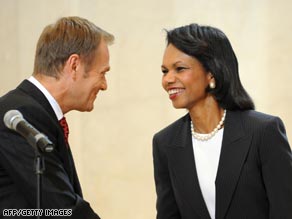
Polish President Donald Tusk and U.S. Secretary of State Condoleezza Rice.

Polish President Donald Tusk and U.S. Secretary of State Condoleezza Rice.

Signing the deal with Polish Foreign Minister Radek Sikorski, U.S. Secretary of State Condoleezza Rice hailed it as a breakthrough in international cooperation but stressed the missiles would only be used for defense.

"It will help both the (NATO) alliance and Poland and the United States respond to the coming threats," Rice said after the signing. "Missile defense, of course, is aimed at no one. It is in our defense that we do this."

Moscow says the missile-defense system is aimed at blunting Russia's nuclear deterrent. It has warned the deal could open Poland up to attack.

Polish Prime Minister Donald Tusk, whose country has been pushing for the missile-defense system to be placed in Poland, said it strengthens the two countries' strategic partnership and will bring long term benefits to their security.

The agreement will put a ground-based ballistic missile defense interceptor facility with 10 interceptor missiles in Poland close to the Russian border, according to the declaration. The United States will begin deploying the Patriot air and missile defense system next year, with a garrison to support it by 2012. Explainer: The basics of missile defense »

The countries will negotiate a separate agreement for the status of U.S. forces in Poland to support the system, the declaration says. The United States will also provide training to Poland and provide real-time information about missiles tracked by the radar, which will be located in the Czech Republic.

Tusk said the Patriot battery and U.S. installation are a "practical and measurable element of this breakthrough" agreement.

"Missile defenses, including an interceptor base in Poland, provide a necessary and critical capability that can be used to defend both nations and other NATO allies from long-range missile threats" launched from the Middle East, the declaration says.

The system will be linked to other missile defense facilities in Europe and the United States, the declaration says.

Without referring to Russia, the declaration notes that the U.S.-Poland relationship is governed by the NATO charter "which provides that an armed attack against one NATO country shall be considered an armed attack against them all."

The United States will help Poland modernize its armed forces as part of the deal, thus making Poland a stronger NATO partner. The two countries also agreed to deepen cooperation on political-military issues, information-sharing and defense technology research and development.

Polish President Lech Kaczynski said the deal is strategically necessary for Poland and for Europe.

advertisement

While it pushed for the system, Poland had made some demands of the United States and that had stalled negotiations in recent months. The pace of the talks accelerated, however, after Russia invaded Georgia nearly two weeks ago, and the countries quickly ironed out their differences

"The negotiations have sometimes been tough but they have never been unfriendly," said Rice. "They have sometimes been difficult but they have always been purposeful."

Gas price decline nears 40 cents

Gasoline prices have fallen nearly 40 cents a gallon from their record highs after 34 straight days of declines, according to a daily survey released Wednesday.

The price of regular gasoline fell to $3.717 a gallon from $3.73 a day earlier, according to a survey of gas station credit card swipes from motorist group AAA and the Oil Price Information Service.

Gas prices have fallen more than 9% since hitting a high of $4.114 a gallon on July 16. The drop mirrors a 22% decline in crude price futures from their record high of $147.27 a barrel.

A major test for energy prices comes Wednesday when the government issues its weekly inventory report. Analysts surveyed by energy information service Platts expect gasoline supplies to have declined 3 million barrels, a signal that - squeezed between high crude prices and lower consumer demand for pricey fuel - refiners faced with razor-thin profit margins may have been forced to cut back production

Diesel: Diesel fuel, which is used to power most trucks and commercial vehicles, fell to $4.359 a gallon from $4.373 a day before, according to AAA.

Because of its use in shipping and transportation, high diesel prices can drive up operating costs, which companies then pass along to buyers by raising prices.

High fuel prices were partially responsible for driving wholesale prices up 9.8% over the past 12 months, the sharpest yearly jump since the 1980s.

Ethanol: The price of E85, an 85% ethanol blend, fell to $3.035 a gallon on average from $3.041, AAA reported.

Expensive petroleum-based fuels have helped raise the profile of corn-based ethanol, which can be used as a gas alternative in specially configured "flex-fuel" vehicles.

However E85 fuel is difficult to find outside the corn-producing midwest region, and is not sold in some states. It also generally burns less efficiently than gasoline.

According to AAA estimates, drivers of flex-fuel vehicles running E85 would have to pay the equivalent of $3.994 a gallon to get the same mileage as gasoline.

State prices: Gasoline remained above an average of $4 a gallon in four states, according to AAA: Alaska, the most expensive state at $4.576 a gallon, Hawaii at $4.435 a gallon, California at $4.018 and Utah at $4.014.

The cheapest gas on average was found in Missouri at $3.484 a gallon, followed by South Carolina at $3.496.

Diesel prices were most expensive in Hawaii, with drivers paying an average of $5.309 a gallon. Diesel was cheapest in Missouri, where prices fell to an average of $4.085

Plane crashes in Madrid, casualties reported

A plane belonging to one of Spain's three major private carriers went off the runway at Madrid's Barajas Airport Wednesday, an airport official said.
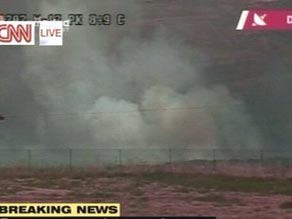
Smoke could be seen rising from the end of the runway at Madrid's Barajas Airport.

Smoke could be seen rising from the end of the runway at Madrid's Barajas Airport.

Clouds of gray and black smoke were rising from the site. There are believed to be injuries, the official said.

The incident happened as Spanair Flight 5022 was taking off from the main runway, the official said. It was headed to Las Palmas in the Canary Islands, a more than two-hour flight.

Spanish media reported there were 160 people onboard.

Sunday, August 17, 2008

Hundreds evacuated from Grand Canyon flooding

Heavy overnight rains flooded a stretch of the Colorado River through the Grand Canyon, forcing the evacuation of hundreds of tourists and residents, officials said Sunday.

The rains caused a breach at the earthen Redland Dam early Sunday, sending a rush of water into the Supai village, which includes a portion of the Hualapai Indian Reservation, said Gerry Blair, spokesman for the Coconino County sheriff's department.

He said helicopters were evacuating more than 200 campers, paddlers and other tourists, and another 200 residents of the Supai area.

The evacuees are being taken to a Red Cross shelter in Peach Springs.

Meanwhile, three empty tour boats were spotted down the river, but all 16 occupants were located on a ledge off the river bank, said Maureen Oltrogge, spokeswoman for Grand Canyon National Park. All 16 were airlifted from the scene and transported to the shelter.

More rain was forecast for the area Sunday afternoon, according to the National Weather Service.

lol cnn.com typo


apparently Phelps won a Hispanic gold medal.

Septuplets' mother has only seen them on TV

An Egyptian mother of septuplets says she's only seen her babies on TV but hopes to hold them and name them soon.
Nurses attend to the septuplets at a the El-Shatbi Hospital in Alexandria, Egypt.

Nurses attend to the septuplets at a the El-Shatbi Hospital in Alexandria, Egypt.

Ghazala Khamis is still hospitalized after giving birth Saturday to four boys and three girls. She told The Associated Press on Sunday that she's "very anxious to see them" and to breast-feed at least some of them.

She says she's "only watched them on TV" and finds them "very cute."

Her doctor, Emad Darwish, said the babies remained in incubators but were in a good condition. He said they weighed between about three and six pounds.

Khamis took fertility drugs to conceive, and was hospitalized two months ago in Egypt's coastal city of Alexandria. She is already the mother of three girls.

The woman's brother, Khamis Khamis, said Saturday that even though his sister was trying to conceive more children so she could have a son, the family was astonished when they found out she would give birth to multiple babies.

"We thought about an abortion, but then we felt it's religiously forbidden. So we said, 'Let God's will prevail,' " he said.

Egypt's health minister announced that the seven babies would receive free milk and diapers for two years, the brother added.

Saturday, August 16, 2008

Firefox hack attack warning

Several security holes have been discovered in Firefox and other software from Mozilla.

The Thunderbird e-mail program and the Seamonkey program suite have also been affected.

Users should update their software as soon as possible once patches become available, recommends the German Federal Agency for Security in Information Technology (BSI) in Bonn.

The warning applies to Firefox versions prior to 2.0.0.16 and 3.0.1 as well as to Seamonkey. In the latter case, any version prior to 1.1.11 is vulnerable to hacker attacks.

Those who do not receive automated updates can download them manually at http://www.mozilla.com/firefox or http://www.seamonkey-project.org/releases.

No update is available as yet for Thunderbird, which is affected in all versions prior to 2.0.0.16.

BREAKING: NEW PHOTO OF BIGFOOT

A policeman and a former corrections officer say that on Friday they will unveil evidence of what they claim is their biggest find ever: the body of Bigfoot.
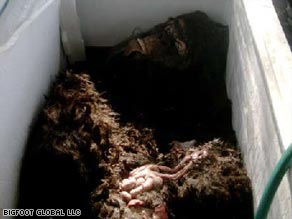
The thawed body of a creature reputed to be Bigfoot reportedly weighs more than 500 pounds.

The thawed body of a creature reputed to be Bigfoot reportedly weighs more than 500 pounds.

Click to view previous image
1 of 2
Click to view next image

Matthew Whitton and Rick Dyer, a pair of Bigfoot-hunting hobbyists from north Georgia, say they found the creature's body in a wooded area and spotted several similar creatures that were still alive.

The carcass of the furry half-man, half-ape is 7 feet, 7 inches tall and weighs more than 500 pounds, they say. However, the two are not disclosing the exact location of their discovery to protect the remaining creatures.

Tom Nelson, chairman of the biology department at North Georgia College and State University in Dahlonega, said he's "pretty skeptical" the world will feast its eyes on a new species Friday.

"That would certainly rock mammalogy," joked Nelson, who specializes in the study of mammals. "I see a research grant in my future."

Whitton and Dyer plan to unveil what they say is DNA and photo evidence of the discovery in Palo Alto, California, in conjunction with a group called Searching for Bigfoot Inc.

A photograph on that group's Web site shows what appears to be the body of a large, hairy creature with an ape-like face, stuffed into a large freezer.

According to a written release, the two announced the discovery on an Internet radio show, "Squatch Detective," several weeks ago. iReport.com: Do you believe in Bigfoot?

"The only person we would allow to come down and verify the body was 'the Real Bigfoot Hunter,' Tom Biscardi," Dyer said, referring to Searching for Bigfoot's CEO, who has been looking for the elusive, legendary creature in the United States and Canada since 1971.

Whitton is a Georgia police officer who is on administrative leave after being shot in the wrist during a pursuit. Dyer is a former prison guard.

DNA tests on the body have begun, said the statement, and "extensive scientific studies" will be done on the body by scientists, including a molecular biologist, an anthropologist and a paleontologist.

Nelson, the university professor, acknowledged that new species of animals have been discovered in recent decades and that, in science, "we always acknowledge the possibility of something new."

But he said that even in north Georgia, home to the Blue Ridge Mountains and the foot of the Appalachian Trail, it stretches the imagination to think a family of 7-foot-tall creatures could have eluded hunters, hikers and creeping development until now.

"To the average person, these places just seem like extreme wilderness where you'll find lions and tigers and bears," he said. "The reality is that you're never more than a mile from a road."

The group says the animal is male, has reddish hair and "blackish-gray" eyes and human-like feet, hands and teeth.

BREAKING: Phelps claims Olympic-record eighth gold medal

http://i2.cdn.turner.com/si/2008/olympics/2008/08/16/bc.oly.swm.phelps.medley.relay.ap/t1_0817_phelps.wins_ap.jpg

BEIJING (AP) -- Cheering from the pool deck, Michael Phelps won his record eighth gold medal of the Beijing Games on Sunday to become the grandest of Olympic champions.

Jason Lezak held on to the lead Phelps gave him, anchoring the United States to a world record in the 400-meter medley relay against an Australian team that did its best to spoil history.

But Phelps, with a big hand from three teammates, would not be denied. He eclipsed Mark Spitz's seven-gold performance at the 1972 Munich Games, an iconic performance that was surpassed by a swimmer fitting of this generation: a 23-year-old from Baltimore who loves hip-hop music, texting with his buddies and wearing his cap backward.

"I don't even know what to feel right now," Phelps said. "There's so much emotion going through my head and so much excitement. I kind of just want to see my mom."

Debbie Phelps was sitting in the stands at the Water Cube, tears streaming down her cheeks, her two daughters by her side. After getting his gold, Phelps quickly found his family, climbing through a horde of photographers to give all three of them a kiss.

Mom put her arm around his neck and gave him a little extra hug.

Her son sure earned it.

"The Beijing Olympics has witnessed the greatest Olympian of all time -- Michael Phelps of the USA," the announcer said as Phelps posed on the deck with his teammates.

Even though the Americans have never lost the medley relay at the Olympics, the latest win was hardly a breeze. When Phelps dived into the water for the butterfly -- the third of four legs -- the Americans were third behind Japan and Australia.

But Phelps, swimming the same distance and stroke that he used to win his seventh gold a day earlier, powered to the front on his return lap, passing off to Lezak with the Americans in front.

Australia's Eamon Sullivan tried to chase down Lezak and appeared to be gaining as they came to the wall. But Lezak touched in 3 minutes, 29.34 seconds -- Phelps' seventh world record in his personal Great Haul of China.

The Aussies took silver in 3:30.04, also under the old world record, while Japan held on for the bronze.

"Nothing is impossible," Phelps said. "With so many people saying it couldn't be done, all it takes is an imagination, and that's something I learned and something that helped me."

Phelps patted breaststroker Brendan Hansen on the head and threw his arms in the air after Lezak finished, though the Americans still had to wait a couple of tantalizing minutes for the official results to be posted. Aaron Peirsol swam the leadoff leg for the Americans.

Finally, it flashed on the board.

World record.

Gold medal No. 8.

On deck, a beaming Phelps slapped hands with his teammates and thrust his arms toward the Water Cube roof. The winning swimmers locked arms as if they were in a football huddle about to break for a play.

Phelps, who won five individual races and three relays in Beijing, couldn't stop smiling. He also gave a shout-out to those who helped him take down Spitz.

"Without the help of my teammates this isn't possible," he said. "I was able to be a part of three relays and we were able to put up a solid team effort and we came together as one unit.

"For the three Olympics I've been a part of, this is by far the closest men's team that we've ever had. I didn't know everybody coming into this Olympics, but I feel going out I know every single person very well. The team that we had is the difference."

Phelps won some races by ridiculously large margins, others with the closest of finishes -- most memorably, his seventh gold by one-hundredth of a second over Serbia's Milorad Cavic in the 100 fly.

He set seven world records and one Olympic record, doing a personal best time in every event.

"It's been nothing but an upwards roller-coaster and it's been nothing but fun," Phelps said.

After receiving his gold, Phelps received another award from FINA, the sport's governing body, as the best swimmer of the meet.

Make it the best ever.

Speed Up Windows XP


The Windows XP desktop. Image courtesy Microsoft

Despite Microsoft's best marketing efforts, you haven't yet upgraded to Vista. You still prefer your trusty old copy of Windows XP. And, despite your diligence in protecting your beloved XP machine from viruses and sneaky trojan horses, Windows is noticeably slower than when you first installed it. Don't panic -- there are a number of things you can do to get your XP system running faster.

Keep in mind though, that, while these tips listed below can help you speed up Windows and recover hard drive space, you aren't going to see the sort of speed boost you'd get from upgrading your key hardware components. If you're unhappy, for instance, with the write speed of your hard drive, a few of these tips may help, but not nearly as much as upgrading to an ultra-fast Serial ATA (SATA) drive capable of 10,000 RPM. Also, adding more RAM almost always brings life to an older, slower system.

Defragment Your Hard Drive

XP's Disk Defragmenter. Image courtesy of Microsoft

Once the go-to solution for all speed problems in Windows, Windows Vista has largely eliminated the need for defragmenting by doing it automatically in the background. In Windows XP, however, defragmenting is still a fact of life.

Fragmentation happens when the computer writes files to disk without keeping everything together in one spot. Thus, if you just saved a large image you've been working on in Photoshop, part of it might be near the middle of the disk and part of it might be at the end, which means it takes longer for the disk to find it. Bring those separate parts together is what's known as defragmenting.

In XP, it's fairly simple process. However, note that you won't be able to use your computer while it's busy defragmenting. And if it's been a while since you defragmented, it can take some time. In other words, don't do this in the middle of busy day at the office.

To defragment your boot drive, open My Computer and right-click the disk you want to defragment. Select Properties and then click the Tools tab where you'll see the Defragment Now option. Just click Defragment and wait for the process to finish.


Improve Startup Times

Whenever Windows starts it automatically loads a number of programs, many of which you may not need. Unfortunately stopping programs from running at start-up isn't easy because there's several places these programs can live.

The three main places to investigate are the Startup folder, inside logon scripts and, in some cases, the Registry. By far the easiest of these is the Startup folder which can be found here:

C:\Documents and Settings\username\Start Menu\Programs\Startup

Just open the folder and delete the shortcuts to any programs you don't need when you start Windows.

Tip: You can also clean out the startup items by navigating to Start >> Programs >> Startup and then right-clicking items you want to remove.

To get to the other startup items, open up a command window and type msconfig. Look for the Startup tab and uncheck the box next to the program. Be careful though. Some items in here are required for Windows to function properly, and sometimes it's difficult to tell what a program actually is.

Tip: Maximize the window so that you can see the full file path to the application. In most cases, that will give you a better idea whether or not you need that application.

Another thing to clean is the Scheduled Tasks folder (C:\Windows\Tasks) where you can get rid of any programs that you don't want to run automatically on a schedule.

Keep in mind when you're disabling things that it's better to try them one at a time rather than disabling programs in large batches. That way if you restart and something isn't working you know the culprit.


Turn Off Unnecessary Services

Services are background processes that run silently without you ever knowing about them. Because Windows takes the everything-and-the-kitchen-sink approach there's likely to be some unnecessary services running in the background.

To get rid of them go to Start >> Run, type "services.msc" and hit return. Double-click on the service you want to get rid of and change the startup type to Disable.

Here are some examples of services you may not need: Alerter, Distributed Link Tracking Client, Fast User Switching, Indexing Service, Netmeeting Remote Desktop Sharing, Secondary Logon, Telnet and Workstation. There are dozens more you sift through to see if you need them and run a few rigorous web searches to see if you need all of them.

Use caution. If you disable the Computer Browser service, for example, you might find that you can no longer connect to computers on your local network. Before you make changes to unknown services, see if you can find a source that quantifies the exact performance gain you'll see from making this change. Many will only reclaim a few megabytes of RAM.


Clean House

Ccleaner
Ccleaner

Like most people, you probably have a number of files and programs you don't need that are eating up dard drive space. When it comes to files it's your call, but for getting rid of programs we recommend the free application CCleaner which is faster and much more thorough than the default Add/Remove application provided with Windows.

Optimize Your BIOS

Gladiator BIOS, screenshot courtesy of Foxconn

The BIOS is a set of instructions that's hard-wired into your computer's motherboard. It stands for Basic Input/Output System, and it's responsible for initializing the hardware on your computer whenever it boots up. Tweaking your BIOS will only provide small performance gains on most computers, but on heavily-customized or recently upgrade older computers, it can make a noticeable difference.


Update Your BIOS. Most computer manufacturers and motheboard manufacturers regularly release updates to their BIOS versions. Check with the company which manufactured your computer or its motherboard for the appropriate download. You can usually find out which BIOS version you're running in the BIOS's settings. In the old days, they used to use floppy discs. Now, BIOS upgrades can be performed using bootable CD-Rs or installers that run within Windows. If you need to update your BIOS, the download should come with instructions.


Disable Unused Ports. Are you using that parallel port? What about the VGA port? Have a look at the back of your PC and see if there's anything that you don't have a monitor, scanner or some other peripheral attached to. Then, go into the BIOS when your computer boots and disable that port. You can usually find them in a menu called "integrated peripherals." If you need the port in the future, go back into the BIOS menu and enable it.


Turn Off Built-in Features On Your Motherboard. Most motherboards have a lot of the basics, like RJ-45 networking and sound, built-in. Some even ship with RAID controllers or other fancy hardware you're not using. If you've recently upgraded to a better sound card, you can disable the one that came installed on your board. Likewise if you installed a wireless card -- you won't be needing that Ethernet component any longer. Disable the built-in components you're not using by turning them off in the BIOS. Just like disabling ports, you can always turn them back on if and when you need them.


Russia accord signing is 'hopeful step': Bush

US President George W. Bush said Saturday that Russia's signing of a peace deal over its conflict with Georgia is a "hopeful step."

Speaking from his ranch in Crawford, Texas just hours after Russian President Dmitry Medvedev signed a French-brokered ceasefire deal, Bush told reporters: "It's a hopeful step."

"Now Russia needs to honor the agreement and withdraw its forces," he added.

Pilot lost control of Obama's plane

THE pilot at the controls of a plane carrying Democratic presidential candidate Barack obama was having trouble controlling it before an emergency landing last month, tapes have revealed.

http://www.news.com.au/common/imagedata/0,,6198867,00.jpg

At the time, the Federal Aviation Administration (FAA) and Midwest Airlines, owner of the MD-80 charter airliner, said there was no emergency when Senator Obama's campaign plane made an unscheduled landing in St Louis last month.

ABC News said today that tower tapes it obtained through a Freedom of Information Act request showed the pilot, who was having trouble controlling the pitch of the plane, told an FAA air traffic controller "at this time we would like to declare an emergency and also have CFR (crash equipment) standing by in St Louis".

FAA spokeswoman Laura Brown did not dispute the network's account.

She said news media were told minutes after the incident happened that there had been no emergency because that was the initial information passed to the agency's public affairs staff by air traffic control.

She said no one went back later to confirm the nature of the incident.

"Information we get in real time is preliminary and may be subject to change when we get a fuller account of what happened," Ms Brown said, according to the Associated Press.

"We didn't have any real reason to go back and question what we were told initially ... Nobody called us to question that."

The control tower tapes revealed the pilot reported he no longer had 100 per cent control, with only "limited pitch authority" of the aircraft, ABC reported.

"There are many situations in which a pilot declares an emergency and in the vast majority of cases the pilot lands the plane safely," Ms Brown said.

"Declaring an emergency gives that aircraft priority and ensures there is rescue equipment available in case there is a real problem."

After the plane landed, Senator Obama read the paper in the front cabin, but went to chat with his travelling press corps at one point.

"I just thought we'd spice things up a little bit today," Senator Obama joked.

He later called the incident a "little glitch".

The National Transportation Safety Board, which is investigating the incident, said an initial examination of the plane found no evidence of missing parts or tampering, federal investigators said today.

Russia threatens Poland with nuclear strike

A top Russian general says Poland's deal with the US to set up parts of a missile defence shield on Polish territory lays it open to a possible military strike.

Col-General Anatoliy Nogovitsyn, deputy chief of the general staff, told Interfax that Russian military doctrine would allow for a possible nuclear strike.

Poland agreed on Thursday to host elements of a US global anti-missile system after Washington agreed to boost Poland's own military air defences.

"The USA is engaged in an anti-missile defence for its own government, and not for Poland. And Poland, in deploying (elements of the system) opens itself to a military strike. That is 100 percent," Interfax quoted Nogovitsyn as saying.

Nogovitsyn said Russia allows nuclear weapons to be used in circumstances defined by its current security doctrine.

The Russian government revamped its national security doctrine in 2000, broadening the range of conflicts in which nuclear weapons could be used.

"It is written clearly: We will use it in instances against governments that have nuclear weapons; against allies of countries with nuclear weapons, if they somehow enable them," he said.

Washington says the missile system is aimed at protecting the United States and its allies from long-range missiles that could in the future be fired by Iran or groups such as al Qaeda.

The Kremlin has long said that was untrue, and has opposed the shield as a threat to Russia. The 10 interceptor missiles to be based at a site in northern Poland compare with Russia's own nuclear arsenal of more than 5,000 ballistic warheads.

In agreeing to deploy elements of the US missile shield, Poland "becomes an actionable object. Those targets are destroyed in the first order," Nogovitsyn said.

Tension between Moscow and Washington has risen in the past week, since Georgia's attempt to re-take its separatist region of South Ossetia by force provoked a massive counter-attack by Russia.

Legendary music producer Jerry Wexler dies

LEGENDARY music producer Jerry Wexler, who coined the term "rhythm and blues'' and shaped the careers of stars such as Ray Charles and Aretha Franklin, has died aged 91, a record company said today.

Wexler, who helped run Atlantic Records in a successful partnership with Ahmet Ertegun from 1953 to 1975, died at his home in Florida, Atlantic said in a statement released on the Warner Music Group website.

No cause of death was revealed but US media reported that Wexler had died of congenital heart disease.

During 22 years with Atlantic, Wexler worked with some of the music world's biggest names, including Charles, Franklin, Wilson Pickett, Otis Redding, Willie Nelson, Cher, Dusty Springfield and Bob Dylan.

"The history of Atlantic Records and of sound of contemporary music would be very different without the impact that Jerry's great ears, uncanny intuition, and true genius had on countless artists and their music,'' Atlantic said.

"He will be deeply missed by those who knew him and, more importantly, by the millions who - knowingly or unknowingly - have heard his phenomenal body of work.''

Wexler, who was inducted into the Rock and Roll Hall of Fame in 1987, was born in New York in 1917 and served in the Navy during World War II.

After serving in the military he joined Billboard Magazine as a journalist, where he famously coined the term "rhythm and blues'' before joining Atlantic as a partner in 1953.

At Atlantic he presided over a golden age of music, overseeing classic recordings by the likes of soul legend Charles, the Drifters and Ruth Brown.

In the 1960s, notable collaborations included Springfield's "Dusty in Memphis'' album, and later he and Ertegun signed Led Zeppelin to Atlantic.

After leaving Atlantic in 1975, Wexler joined Warner Bros Records, where he worked with Dylan on the album "Slow Train Coming.''

"He understood music and musicians in a way few label executives did, and was able to inspire them to do their best and most original work,'' Atlantic said.

"Our condolences go out to Jerry's family and friends during this sad and difficult time.''

Wexler once described his style as being "the guy in the middle who is neither an engineer nor a musician, but an ear to hear what is happening.''

"You keep it rolling; you know the choices that must be made,'' he said. 'In my analysis, the final determination is that if you can't go out and change the music, you aren't a producer. You are merely presiding at a happening.''

We loved it - then Google got creepy

IF I told you this week I went to an ex-girlfriend's house, sat out the front, took photographs, filmed it and then posted all that online, you'd probably call me slightly deranged.

Obsessed, if you will.

Some of you may say I'm extremely normal, but you're probably in jail.

And if I actually did do all that, I'd be inclined to agree - it's not right (I just sat in the car and maybe took one photo. But that's it, I swear).

Though if I happened to be a successful, billion-dollar US search engine called Google, then suddenly it's OK.

I think Google is becoming more and more like Big Brother - and I'm talking about the real one, not the George Orwell version.

Google's first-off uber-cool "mapping" program, Google Earth, was exciting.

You'd look for your house, and verify that yes, it does in fact have a roof.

Or you might search for places you'd visited around the world, and see them from a perspective that probably wasn't as good as the ground level view you had at the time.

The new technology had a practical side to it as well, as primary schools with an abundance of overweight children could now use Google Earth to take class photos.

I found the best use was for locating those with a swimming pool, then aiming to befriend them. "Hi, I'm Adam; I'm from six suburbs over.

"Here, have a cake. Let's be friends."

You could look up just about anything, unless of course George Bush was in town - in which case the maps were fuzzier than a CIA prosecution case at Guantanamo Bay.

Then Google went too far. It got in our faces. In our personal space. In our homes. Sort of.

It gave Australia "Street View".

Theoretically, most people didn't mind the idea of Google Street View.

It seemed a cool idea, like wearing thongs in winter or visiting Georgia.

Then the reality kicked in as people saw their houses. And in some cases, themselves.

Which made it all a bit creepy.

If you are one of the few who is yet to see their house online, and would like to know what the feeling is like, imagine this: someone calling your mobile and saying, "Hey, I love what you're wearing today."

We were OK with satellite shots, as satellites didn't show us walking to the letterbox in our undies. Or capture us putting a burning tyre in the recycling bin.

But this had gone that step too far.

I'm yet to understand the true value of Street View; clearly, it's not a mapping tool.

Surely no one has ever been that confused by a street directory. "Oh no, the street's going on to a different page, we're doomed!" Personally, I've never had a problem with the tried and true house numbering system either. "Well, it says 46, but you just can't be too sure. Wish I had a photo."

One of the main complaints was the security risks Street View presented.

Though I doubt this has anything to do with Google. How many people were actually sitting around yelling, "Bloody Google! Now I'm going to have to put a front door on our house!"?

Fortunately Street View is a novelty.

We'll tire of it, just as we did with Celtic tattoos, puffy vests and safe Qantas flights.

I think that Google just needs to back off.

With its intrusive ways, it ruins lives on a daily basis. You can't do anything without Google being involved these days.

Imagine I meet someone and attempt to go on a date. First, she checks my history by Googling me.

She then visits Google Street View to see my house, and how well groomed my nature strip is. What next? She's calling me saying, "Yeah, I'm sorry - I just looked you up on Google Colonoscopy, and we can't go out. You should see a doctor.

"But I went to Google Clothes; I love what you're wearing today."

Top dog penguin honoured with knighthood

A THREE foot tall penguin named Nils Olav has received a knighthood - adding to his medals for good conduct and his role as honorary colonel-in-chief of the Norwegian King's Guard.

The esteemed bird - who resides at Scotland's Edinburgh Zoo - is the latest incarnation of the original Nils Olav who was made an honorary member of the elite King's Guard in 1972 after he was chosen as a mascot by lieutenant Nils Egelien.

Zoo spokeswoman Maxine Finlay said the guards adopted the penguin following one of their regular visits to the zoo during the annual Edinburgh Military Tattoo, Associated Press reported.

When the original Nils Olav - named in honour of Egelien and Norway's then-King Olav V - died, he was replaced by a second bird, who inherited his name and rank.

The current Nils Olav is the third penguin to serve as the guards' mascot.

He was promoted to honorary colonel-in-chief in 2005, Finlay said.

During yesterday's knighthood ceremony, Nils Olav was honoured with with speeches and a fanfare before his arrival under escort by the guard's Color Detachment.

Nils dutifully reviewed the troops outside his enclosure at the zoo before he was knighted by British Maj. Gen. Euan Loudon on behalf of Norway's King Harald V.

Russia signs cease-fire, tensions remain high

Russian President Dmitry Medvedev has signed the cease-fire plan designed to end its military conflict with Georgia, his office says.
Russian President Dmitry Medvedev has signed a cease-fire deal designed to end the conflict with Georgia.

Russian President Dmitry Medvedev has signed a cease-fire deal designed to end the conflict with Georgia.

However, a Russian Foreign Ministry spokesman said it would not completely withdraw from Georgian territory until troops had finished cleaning up ammunition, weapons and boobytraps left behind by Georgian troops.

Medvedev saw the cease-fire as "very positive," said spokesman Andrei Nesterenko Saturday.

Georgian President Mikheil Saakashvili signed the deal Friday, during a visit from U.S. Secretary of State Condoleezza Rice. Video Watch more on cease-fire »

It has been the toughest week in east-west relations since the end of the Cold War after Georgia launched an offensive against the Russian-allied separatist government in South Ossetia and Russia responded by invading, the conflict also spreading to a second breakaway region -- Abkhazia.

The fighting has died down, but Russian troops remained within 25 miles (40 kilometers) of Georgia's capital Tbilisi Saturday, and were still on the western front around the breakaway section of Abkhazia, according to CNN's Frederik Pleitgen.

Nesterenko told CNN the troops were "completing security operations," which included removing "huge depots" of ammunition and equipment and boobytraps left behind by retreating Georgian troops.


The fighting has raised fears a new era of east-west confrontation was drawing closer, which was worsened Friday by Russian anger over a U.S. deal with Poland to base part of its missile shield in the country.

The deal, signed Thursday, would see U.S. interceptor rockets based in Poland and linked to an air-defense radar system in the Czech Republic.

Gen. Anatoly Nogovitsyn, a top Russian officer, highlighted Russia's anger with the system, saying that Poland was now at risk of attack, perhaps with nuclear weapons, The Associated Press reported. View a map of the region »

Poland moved to diffuse the situation Saturday, saying it was open to Russian inspections of the missile interceptor base, AP reported. However, the Ukraine said it was interested in joining a joint missile defense system with other European countries.

Ukraine Foreign Ministry spokesman Liubov Abravitova would not specify if it was referring to the U.S. system. Video Watch devastation in port of Poti »

Ukraine also warned Russia it may not allow its ships involved in blockading Georgian ports to return to Crimea bases it leases from Ukraine.

The U.S. maintains its missile shield is to deter rogue attacks from Iran, but Russia says it is aimed at it.

The level of rhetoric on both sides has grown louder through the week, U.S. President George W. Bush chiding Russia for Cold War-style behavior in its territorial conflict with Georgia, accusing it of "bullying and intimidation."

Medvedev said Russia would "guarantee" peace in the Caucasus region but made no commitment to remove its forces from Georgia or its breakaway territories.

Meanwhile Rice warned Russia that it had to withdraw its troops after the cease-fire deal was signed.

Rice said international observers followed by neutral peacekeepers should be dispatched quickly to Georgia and its separatist regions of South Ossetia and Abkhazia, where Russia has a peacekeeping mission. Video Watch Rice demand Russia's withdrawal »

The conflict began late last week, when Georgia launched a military incursion into South Ossetia in an effort to rout separatist rebels.

Russia -- which supports the separatists, many of whom claim Russian citizenship -- has peacekeeping responsibilities for the region and responded by sending tanks into the province for what it said was peace enforcement. From there the violence spread into Georgia and Abkhazia.

Under the cease-fire, about 1,500 Russian peacekeepers are allowed to remain, and can do patrols about 6 kilometers outside, the "zone of conflict," a reference to South Ossetia and Abkhazia.

They are not permitted to patrol in Gori and other Georgian cities and cannot hamper aid distribution or control ports, highways or railroads, the officials said. Video Watch President Bush on 'why Georgia matters' »

advertisement

It is unclear how many people have been killed in the conflict, but various claims put the figure in the thousands.

The U.N. High Commissioner for Refugees said Friday that it estimated that more than 118,000 people have been displaced by the fighting, citing statistics supplied by the Russian and Georgian governments.

Thursday, August 14, 2008

Canadian 'swirl face' pedophile jailed

A Canadian teacher arrested in Thailand after an unprecedented Interpol manhunt has been sentenced to three years and three months in prison for kidnapping and sexually abusing an underage boy.

Christopher Paul Neil, 33, was seized in northeastern Thailand last October following a campaign by the international police agency Interpol, which had reconstructed a series of digitally "swirled" Internet images of a man abusing boys.

The court in Bangkok reduced his sentence from six years and six months, citing Neil's confession. He was also ordered to pay a $2000 fine.

Neil did not say anything as he left the courtroom in shackles and an orange prison uniform, but smiled at reporters.

He was convicted of molesting a 13-year-old boy. Neil still faces charges in a separate case of molesting the boy's nine-year-old brother.

Wrestlers 'still shocked' over Benoit murders

The world of professional wrestling is "still in shock" over the Chris Benoit murders, according to one of the sport's biggest names.

World Wrestling Entertainment (WWE) star Dave "The Animal" Batista says the wrestling industry is still traumatised by Benoit's double-murder suicide almost 14 months ago.

"Still to this day, I think people are in shock over it and a lot of people are still in denial," the US-based Batista told ninemsn.

"It's just the hardest thing we've ever done … a nightmare come to life."

Batista, 39, spent over five years wrestling with Benoit as two of the WWE's most popular entertainers.

He says the pair were close friends and "had a deep personal trust for each other and … talked about personal issues".

Benoit shocked the world last June when he murdered his wife Nancy and seven-year-old son Daniel in his Georgia home.

The 40-year-old Canadian is believed to have strangled his wife with a cord and used a choke hold to strangle his son before placing Bibles next to their bodies.

He then hanged himself with a weights machine in his basement.

"It's just hard to think of Chris Benoit in that way," Batista said.

"We all loved him so much, and we all respected him so much.

"A lot of us are kind of in denial because we don’t associate the Chris Benoit we knew and loved with the Chris Benoit who did that horrible thing."

Batista was speaking ahead of the WWE SummerSlam event, which is airs on Foxtel on Monday.

US and Poland sign defence deal

Poland has signed a preliminary deal with the US on plans to host part of its new missile defence shield.

Under the agreement, the US will install 10 interceptor missiles at a base on the Baltic coast in return for help strengthening Polish air defences.

The US says the system will protect itself and Europe against long range missile attacks by "rogue states".

Correspondents say the deal is expected to heighten tension between the US and Russia, already strained over Georgia.

Moscow has said the project will upset the military balance in Europe and has warned it will be forced to redirect its missiles at Poland.


We agreed this negotiating phase a week ago, which was... before the events in Georgia


However, Polish Foreign Minister Radoslaw Sikorski told the BBC's World Tonight programme that the timing of the deal had nothing to do with the hostilities.

"We agreed this negotiating phase a week ago, which was... before the events in Georgia, and because of the US calendar there was some urgency," he said.

"But, what is crucial, and what decided the success of the talks over the last couple of days, was that the US offered us new proposals."

Unlike the US, Poland sees Russia as a bigger threat to its security than so-called rogue states such as Iran, the BBC's Adam Easton in Warsaw says.

Russian Foreign Minister Sergei Lavrov is reported to have cancelled a scheduled visit to Poland shortly after the deal was announced.

Modernisation

Polish Prime Minister Donald Tusk announced the agreement on national television shortly before it was signed by Deputy Foreign Minister Andrzej Kremer and US chief negotiator John Rood.

Mr Tusk said Washington had agreed to meet Warsaw's main demands in exchange for hosting the 10 interceptor missiles in a former military base near Poland's Baltic Sea coast.

In return, the US had agreed to help modernise the Polish armed forces and locate Patriot missiles and a garrison of US servicemen in Poland to beef up its air defences, Mr Tusk said.

Poland is reported to have demanded the extra security help as part of the deal after Moscow threatened to target its missiles at any eventual bases.

A White House spokeswoman said US President George W Bush "was very pleased with this development".

"In no way is the president's plan for missile defense aimed at Russia. In fact, it's just not even logically possible for it to be aimed at Russia given how Russia could overwhelm it," she told AFP.

The US signed an agreement with the Czech Republic in July to base tracking radars there as part of the missile defence system.

The US wants the sites to be in operation by about 2012.

US and Poland sign defence deal

Poland has signed a preliminary deal with the US on plans to host part of its new missile defence shield.

Under the agreement, the US will install 10 interceptor missiles at a base on the Baltic coast in return for help strengthening Polish air defences.

The US says the system will protect itself and Europe against long range missile attacks by "rogue states".

Correspondents say the deal is expected to heighten tension between the US and Russia, already strained over Georgia.

Moscow has said the project will upset the military balance in Europe and has warned it will be forced to redirect its missiles at Poland.


We agreed this negotiating phase a week ago, which was... before the events in Georgia


However, Polish Foreign Minister Radoslaw Sikorski told the BBC's World Tonight programme that the timing of the deal had nothing to do with the hostilities.

"We agreed this negotiating phase a week ago, which was... before the events in Georgia, and because of the US calendar there was some urgency," he said.

"But, what is crucial, and what decided the success of the talks over the last couple of days, was that the US offered us new proposals."

Unlike the US, Poland sees Russia as a bigger threat to its security than so-called rogue states such as Iran, the BBC's Adam Easton in Warsaw says.

Russian Foreign Minister Sergei Lavrov is reported to have cancelled a scheduled visit to Poland shortly after the deal was announced.

Modernisation

Polish Prime Minister Donald Tusk announced the agreement on national television shortly before it was signed by Deputy Foreign Minister Andrzej Kremer and US chief negotiator John Rood.

Mr Tusk said Washington had agreed to meet Warsaw's main demands in exchange for hosting the 10 interceptor missiles in a former military base near Poland's Baltic Sea coast.

In return, the US had agreed to help modernise the Polish armed forces and locate Patriot missiles and a garrison of US servicemen in Poland to beef up its air defences, Mr Tusk said.

Poland is reported to have demanded the extra security help as part of the deal after Moscow threatened to target its missiles at any eventual bases.

A White House spokeswoman said US President George W Bush "was very pleased with this development".

"In no way is the president's plan for missile defense aimed at Russia. In fact, it's just not even logically possible for it to be aimed at Russia given how Russia could overwhelm it," she told AFP.

The US signed an agreement with the Czech Republic in July to base tracking radars there as part of the missile defence system.

The US wants the sites to be in operation by about 2012.

Phelps sets world record in 200 IM, claims 6th gold; Lochte gets bronze

Michael Phelps hung on the lane rope in a familiar pose, admiring another world record while his rivals gasped for breath. Make it 6-for-6 at the Beijing Games.

Next up: Mark Spitz and the grandest of Olympic records.

Blowing away the field, Phelps won the 200-meter individual medley in a record 1 minute, 54.23 seconds -- more than two seconds ahead of the next guy. He knocked off his own mark of 1:54.80 set at last month's U.S. trials, his sixth world record in China.

Phelps matched his wins from Athens four years ago, where he also took six golds along with two bronzes. He's already the winningest athlete in Olympic history with 12 golds, but his sights are on eight.

Spitz won seven golds at the 1972 Munich Games. Phelps has two more events to leave little doubt he's the greatest Olympian ever.

Ryan Lochte tried to pull off a daunting double, going against Phelps just 29 minutes after winning the 200 backstroke. He couldn't keep up, though he did hold on for bronze. Laszlo Cseh of Hungary picked up his third silver of the games -- all of them trailing Phelps.

When the official results were posted, Phelps extended his right hand to Lochte in the next lane. The friends shook hands and patted each other on the head.

Later, they yukked it up on the medal stand before Phelps hustled off to grab his racing gear; he had to come right back for the semifinals of the 100 butterfly.

"I switched from my dress sweats to my parka, shoes, threw my cap and goggles on and then they pushed us on out. No time," he said. "The medal was in my warmup jacket."

History can't wait.

A half-hour after winning another gold, Phelps was second fastest behind Milorad Cavic of Croatia in the 100 fly, setting himself up to tie Spitz's record in Saturday's final. World record-holder Ian Crocker of the U.S. bounced back from a disappointing swim in the prelims to post the third-fastest time.

"There wasn't much time," Phelps said, "but I think there's going to be a lot of time for me to rest over the next 18 hours or so, and I'll be able to be ready for tomorrow morning's 100."

If all goes according to plan, Phelps will get No. 7 in the fly -- his signature stroke -- and have the coronation Sunday in the 400 medley relay. The Americans are always heavily favored for gold in that one.

Nevertheless, he's taking nothing for granted, especially in the fly.

"It's never a relief," he said. "Tomorrow is going to be a tough race. For me to be a player in that race, I have to be closer at the 50. If I'm not, then it will be tough. I was over a body length behind at the 50 in the prelims and came up a bit short, so I have to be there."

Still, he showed little signs of tiring from the grueling schedule. He's already raced 15 times and has two more left -- both going for gold.

"I actually don't feel too bad now," Phelps said.

That can't be encouraging for those swimmers who've come up with all sorts of amusing theories for Phelps' dominance. He's from outer space. He's come back from the future in a time machine. He's some sort of human rocket.

The official Xinhua News Agency dubbed Phelps "the American superfish."

Lochte got quite a consolation price: a world record and the first individual gold medal of his career in the backstroke. The laid-back Floridian edged teammate Aaron Peirsol in 1:53.94 to break the mark he shared with Peirsol.

"I touched the wall and was like, 'Thank you, finally,"' Lochte said. "It felt good the whole way."

Lochte was known as "Mr. Runner-up" for his frequent second-place finishes to Phelps and Peirsol. Then he stunned Peirsol at last year's world championships in 1:54.32, before Peirsol matched the time in beating Lochte at the U.S. Olympic trials last month.

Lochte got Peirsol back despite a problem with his LZR Racer.

"My suit came undone after the first 50," Lochte said. "I was just trying to control my legs."

Lochte couldn't tame Phelps, however, which would appear to leave Crocker as the last man standing between Phelps and his destiny.

A thoughtful, 25-year-old from Maine, who loves to cruise in vintage cars and jam on his guitar, Crocker is now trying to go down in history as the man who stopped Phelps.

"You can start by not worrying about what everybody else thinks," he said. "Nobody knows what I've really gone through in the last eight years and what has gotten me to this point, besides myself and a few people that I know well. So it's my own personal deal at this point."

Peirsol won the 100 back in Beijing, but failed to match his backstroke double from Athens four years ago. He earned the silver in 1:54.33, while Russia's Arkady Vyatchanin claimed the bronze.

"That's the theme of the meet. You have to break a world record to win. I gave it my all and I had nothing left," Peirsol said. "I'm very proud of what I've done. Ryan swam well. He earned it."

Rebecca Soni gave the U.S. women's swim team a much-needed boost, setting a world record in the 200 breaststroke with an upset of Australia's Leisel Jones.

Soni had already claimed a surprising silver behind Jones in the 100 breast, a race she wasn't even supposed to be in. She took over when Jessica Hardy failed a doping test at the U.S. trials and was dropped from the team.

Jones was out front over the first 100, but Soni came on strong at the end, finishing a full body length ahead of the Aussie in 2:20.22. She beat Jones' mark of 2:20.54, set two 21/2 years ago in Melbourne.

Soni's victory came about 14 hours after American distance hopes Katie Hoff and Kate Ziegler failed to make the final of the 800 freestyle, and two summers after Soni underwent a minor heart operation.

"It's been a long road to get here, and I really can't believe that just happened," she said.

Jones claimed silver and Norway's Sara Nordenstam took bronze.

"I really couldn't breathe that last 50. I was just digging deep and couldn't breathe," Jones said. "A silver medal is still a silver medal in the Olympics. I gave it everything, I couldn't have given more."

The only non-American gold of the morning went to Germany's Britta Steffen in the 100 freestyle, ahead of Australia's Libby Trickett by four-hundredths of a second. American Natalie Coughlin claimed the bronze for her fifth medal of these games, matching her haul from Athens with the medley relay still to go.

Steffen won in an Olympic-record 53.12.

Phelps' win was the 21st world record set in swimming during the Olympics, with two days left.
U.S., Libya deal closes book on Lockerbie

Libya will pay hundreds of millions of dollars to victims of terrorist attacks involving Americans in an agreement signed and finalized Thursday, the U.S. State Department said.
U.S. Assistant Secretary of State David Welch, left, and Libyan Deputy Foreign Minister Ahmad Fitouri sign the deal.

U.S. Assistant Secretary of State David Welch, left, and Libyan Deputy Foreign Minister Ahmad Fitouri sign the deal.

Assistant Secretary of State David Welch signed the deal in Tripoli, Libya, on Thursday. If implemented, the deal will end Libya's legal liability in numerous lawsuits from families of victims of what the United States considers Libyan terrorist acts. It also paves the way for stronger ties between the two nations and increased U.S. involvement in the oil-rich nation.

"This resolves the last major historical issue that has stood in the way of a more normal relationship between our two countries," Welch said.

The deal had hinged on congressional approval. Last month, just before leaving for summer recess, Congress unanimously adopted the Libyan Claims Resolution Act, sponsored by Sen. Frank R. Lautenberg, D-New Jersey. The legislation cleared the way to end the feud with Libya over terrorist attacks and creates a fund for victim payments.

"The Libyans didn't believe that Congress would ever be helpful, and Congress didn't think Libya would ever do it," Welch said Thursday. "We found a diplomatic way to accommodate both sides by turning suspicion into an asset."

Under the new law, Congress gives the Bush administration the authority to restore sovereign immunity for Libya only when the United States receives the agreed-upon money to pay American claimants in the fund and the secretary of state certifies it. See a timeline of events following the Pan Am attack »

Once the money is received into the fund, Libya would be exempted from legislation passed this year enabling terrorism victims to be compensated from frozen assets of governments blamed for attacks.

The 1988 bombing of Pan Am Flight 103 over Lockerbie, Scotland, killed 270 people, including 189 Americans. The 1986 La Belle disco bombing in Berlin, Germany, killed two American servicemen and injured 79 Americans.

Libya has paid 268 families involved in the Pan Am bombing $8 million each of a $10 million settlement. It was withholding the remaining $2 million owed to each family over a dispute regarding U.S. obligations to Tripoli.

Under the deal, Libya would pay more than $500 million to settle remaining claims from the Lockerbie case and more than $280 million for victims of the La Belle disco, according to Jim Kreindler, the lead attorney for the Pan Am families.

It would also set aside funds to compensate victims of several other incidents blamed on Libya but for which Libya hasn't accepted responsibility. The total settlement could exceed $1 billion.

The pact, supported by the victims' families, closes the book on a contentious period in U.S.-Libyan relations. Ties between the two countries began to improve in 2003, when Libya gave up its weapons of mass destruction program and began compensating Lockerbie victims.

But lingering lawsuits prevented the two countries from fully normalizing ties. A joint U.S.-Libya statement issued Thursday in Tripoli said "both parties welcomed the establishment of a process to provide fair compensation for their respective nationals, and thereby turn their focus to the future of their bilateral relationship."

This spring, Libya made a proposal to the Bush administration that held some promise in settling the dispute, Welch said. Over the next several months, he and State Department lawyers held closed-door negotiating sessions with the Libyan delegation in London, England; Paris, France; Berlin; and Abu Dhabi, United Arab Emirates, where he finally secured a tentative agreement in late July.

The afternoon he came back from Abu Dhabi, Welch met with Lautenberg and urged passage of the legislation.

Welch said Libya would expect an end to the claims and put the longstanding dispute with Libya to rest, despite the lingering mistrust of Libyan leader Moammar Gadhafi.

"This could not have worked without a great deal of honesty on everyone's part," Welch said.

On Thursday, Lautenberg issued a statement expressing satisfaction with the agreement.

"For too many years, Libya has refused to accept responsibility for its horrific acts of terror against American victims," he said.

"The signing of this agreement means these victims and their families can get the long overdue justice they deserve. Today's agreement is a critical development in moving Libya forward on its path toward diplomatic respect," he said.

The State Department said the "agreement is being pursued on a purely humanitarian basis and does not constitute an admission of fault by either party."

Senior State Department officials said the formula was designed to respect Libyan sensitivities about compensating victims for incidents for which it hasn't taken responsibility

But it also allows Libya to settle outstanding claims for U.S. air strikes on Tripoli in 1986, in which Libya claims more than 40 of its citizens were killed, including Gadhafi's adopted daughter.

Donations to settle Libyan claims would be placed in the "voluntary" fund, from which each country involved in the claims draws the money to pay its citizens.
advertisement

Welch said no U.S. taxpayer money would be used to compensate Libya but said he was "optimistic" donations to settle Libyan claims would be made. Other senior U.S. officials said American companies eager to do business in Libya could possibly make a contribution.

The deal is to be followed by a U.S. upgrading of relations with Libya, including the confirmation of a U.S. ambassador and possible American aid. Secretary of State Condoleezza Rice is expected to visit Libya before the end of the year.