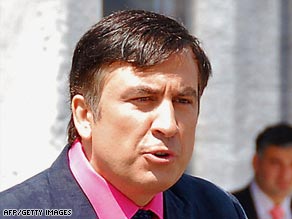
Georgian President Mikheil Saakashvili says Russia has continued to attack the city of Gori.

The six-point deal was meant to end the fighting over the breakaway regions of South Ossetia and Abkhazia, but both sides traded accusations Wednesday.
Russian Foreign Minister Sergey Lavrov used a Moscow press conference to urge Georgia to formally sign the deal.
Meanwhile Georgian President Mikheil Saakashvili, flanked by the leaders of Lithuania, Poland, Estonia and Latvia in a separate media briefing, said Russian tanks were attacking and "rampaging" through the Georgian town of Gori despite the cease-fire.  Watch Saakashvili speak »
However journalists in Gori, the birthplace of former Soviet leader Joseph Stalin, said they had seen no Russian tanks. Residents there told the journalists they had earlier seen "some" Russian tanks, but not in large numbers.
A Russian military official also disputed Georgia's claims. He said Russian forces were at an abandoned Georgian artillery base near Gori, but not inside the town itself.
"I tell you with full responsibility that there are no Russian tanks in Gori today and there is no reason to be," because Gori authorities have fled the city, said General Anatoly Nogovitsyn, deputy chief of the Russian General Staff.
Nogovitsyn said the conflict had killed 74 Russian troops, wounded 171 and left 19 missing in action. Watch more on push for peace »
Saakashvili also accused Russia of carpet bombing Tskhinvali, South Ossetia's capital, and setting up internment camps for residents there and in Abkhazia.
"Georgia has been sticking to its commitments, but I don't think there is much to stick to here," Saakashvili said. Watch more on battle-ravaged South Ossetia »
French President Nicolas Sarkozy said Tuesday that Saakashvili and Russian President Dmitry Medvedev had agreed to the deal, which called for an immediate cease-fire and withdrawal to the positions held before the fighting escalated. iReport.com: Share your story of how the crisis is affecting you
Sarkozy is the current president of the European Union, which mediated the cease-fire.
The deal also allowed displaced civilians to return home safely and opens Georgia to humanitarian aid workers.
Sarkozy acknowledged that the plan was provisional but said a long-term solution was being sought.
French Foreign Minister Bernard Kouchner would present the plan to EU members and eventually make it the basis for a legal document to be reviewed by the U.N. Security Council, Sarkozy said.
Lavrov said it was important for Georgian armed forces to return to their barracks as part of the agreement. Watch more from the frontline »
"The Georgian side must immediately fulfill this key issue, to remove all dangers concerning relapses," Lavrov said.
He reiterated that Russian peacekeepers would remain in South Ossetia, where they were before the fighting erupted last week.
He also called for international observers to help ensure peace and "prevent any aggressive ambitions on the part of the Georgian leadership."
Wednesday was a day of mourning in Russia for what Medvedev called the "genocide" of the South Ossetian people by Georgian forces. Flags across Moscow flew at half-staff.
Lithuanian President Valdas Adamkus said an international force would be the only way to stop violence and ensure Georgia's territorial integrity.
"Let the world finally wake up and take the action and provide the real security for the region," Adamkus said.  Interactive map: See how far the Russians advanced »
Fighting has raged since Thursday when Georgia launched its crackdown on separatist fighters in autonomous South Ossetia, where most people have long supported independence.
Russian troops and tanks moved into South Ossetia on Friday and quickly pushed back the Georgian forces. Russian forces also moved into Abkhazia, another breakaway Georgian region.
Russia called a halt Tuesday to its military incursion, insisting it had been aimed at stopping Georgian military actions against its peacekeepers and citizens in the breakaway regions.
One Russian diplomat told CNN that as many as 2,000 people died after Georgia sent its military into South Ossetia.
Estonian President Toomas Ilves, who spoke at the news conference with Saakashvili, said Russia's actions threatened the independence of former Soviet nations. iReport.com: Georgians rally at Parliament building

"This is the first time that we've actually seen an invasion, a unilateral invasion of a country," Ilves said. "I think we have to think about this long and hard and deeply in the EU [and] in NATO."
Up to 100,000 people are thought to have been displaced in South Ossetia and Georgia. The United States, U.N. agencies, religious groups, and non-governmental organizations have started drives for humanitarian relief.

No comments:
Post a Comment