Thursday, August 21, 2008

3 Texas polygamists indicted by grand jury

A Texas grand jury indicted three more members of a polygamist sect that was raided in April, a Schleicher County official told CNN on Thursday.
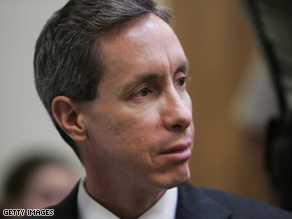
Warren Jeffs and four followers were indicted in Texas in July on child sex abuse charges.

Warren Jeffs and four followers were indicted in Texas in July on child sex abuse charges.

"We have three indictments on three people," said Peggy Williams, the county clerk. "There will be no more information released until the three individuals have been served. We are not releasing names or charges at this time."

Five Texas members of the Fundamentalist Church of Jesus Christ of Latter Day Saints (FLDS), along with the group's leader, Warren Jeffs, were indicted in July in Texas on charges relating to accusations of sexual abuse of children.

Jeffs was charged with the sexual assault of a child, which is considered a first-degree felony. If convicted, he would face a maximum penalty of five to 99 years or life in prison, as well as a fine of up to $10,000.

Four of Jeffs' followers were charged with one count each of sexually assaulting girls under the age of 17, and one of those four also faces a bigamy charge. A fifth follower is charged with three counts of failure to report child abuse.

Jeffs, 52, is the leader and "prophet" of the estimated 10,000-member FLDS, an offshoot of the mainstream Mormon church. The FLDS openly practices polygamy at its Yearning for Zion (YFZ) Ranch outside Eldorado, Texas, and in two towns straddling the Utah-Arizona state line -- Hildale, Utah, and Colorado City, Arizona.

Critics of the FLDS say it forces girls as young as 13 to marry men. It is not affiliated with the mainstream Mormon church, which renounced polygamy more than a century ago. FLDS members maintain that no sexual abuse of children takes place.

Texas authorities raided the ranch in April, seizing more than 400 children who were later returned to their families after the Texas Supreme Court ruled the state had no right to remove the children and lacked evidence to show they faced imminent danger of abuse.

Last November, Jeffs was sentenced to two consecutive terms of five years to life in Utah after being convicted on two charges of being an accomplice to rape in connection with a marriage he performed in 2001 between a 14-year-old girl and her 19-year-old cousin.

He is being held in the Mohave County Jail in Kingman, Arizona, awaiting trial on four charges of being an accomplice to sexual conduct with a minor.

Jeffs has been in custody since August 2006, when he was arrested during a routine traffic stop after spending several months on the FBI's 10 most-wanted fugitives list.

Wednesday, August 20, 2008

Boy plunges ten stories to his death

Jacob Neuman (image courtesy New York Daily News)
Jacob Neuman (image courtesy New York Daily

A five-year-old New York City boy plunged nearly ten stories to his death after he tried to escape from a trapped elevator.

Jacob Neuman and his eight-year-old bother Israel went into the lift just before 9 am on their way to school when it suddenly became stuck between the 10th and 11th floors.

The Brooklyn boys began pushing the elevator buttons when one of the doors partially opened.

Jacob Neuman squeezed through the door and tried to jump to the tenth floor, but slipped and fell down the shaft while his older brother watched helplessly.

Israel Neuman was hysterical according to police and wasn't rescued until a neighbour heard screaming.

"I heard him screaming and crying," Jose Estrada told the New York Daily News.

"He was saying, 'Help! Help!' He was screaming 'My brother! My brother!"

Neighbours told the New York Daily News that the two brothers were inseparable and that Jacob was a 'bright student with a big smile'.

It was later revealed by city officials that the elevator that claimed the child’s life had failed its most recent inspection and malfunctioned five times since February.

Tempers flare at Boobs on Bikes parade


Tempers flared as marchers raising awareness of links between pornography and sexual violence faced off with people watching Boobs on Bikes in Auckland.

"It makes objects out of women - it degrades them and we're sick of people like Steve Crow trampling over the values of our country," said one protester.

The protest organised by Auckland Women's Centre and Stop Demand Foundation began about half an hour before the Boobs on Bikes parade and had about forty protesters.

Among those in the demonstration were four councillors from Auckland City Council, including Cathy Casey whose legal bid to stop the parade was rejected yesterday.

Ms Casey had threatened to lie in front of the parade to stop it but today she did not go through with her threat.

Stop Demand founder Denise Ritchie said the demonstrators had been well received, apart from several sections of Queen St heckling the group.

"It was an excellent opportunity to get our message out there.

"In a perverse way Steve Crow has provided us with a wonderful platform."

Spectators watching the topless women on motorcycles heading down Queen Street booed the second protest, yelling at the demonstrators "You can't stop it!"

Objects were also thrown at members of the protest; one participant reported being hit with an L&P bottle.

Other spectators tried to grab a banner off two people protesting against the parade.

Boobs on Bikes organiser Steve Crow said it was great to see people protesting.

"It's nice to see a few protesters exercising their right to free speech," he said.

The only other tension during the controversial hour long parade was when eggs were thrown from a building on lower Queen St at Mr Crow, with one egg narrowly missing one of four policemen.

Mr Crow, in a black Bentley convertible, led the parade and had instructed the topless women beforehand to keep the jiggling to a minimum and to not do anything that would be deemed offensive.

The parade featured about 30 women baring their breasts to crowds lining the footpaths.

Thousands of people left their office buildings to witness the spectacle. A strong police presence was also evident.

The huge crowd, at times lined six deep, cheered and and snapped the topless women on cellphones and cameras.

There were also few hecklers among the crowd.

One man shouted at Mr Crow, asking him if he was a pervert.

Mr Crow replied he was not a pervert, he was comfortable with who he was and what he did, and it was the man on the sidewalk who was the pervert.

Auckland police were unable to give a crowd estimate but spokeswoman said an officer Noreen Hegarty quoted the officer in charge as saying "plenty more people than last year."

She said there were no arrests and the crowd was orderly.

While the crowd was predominantly male from all age groups and professions, many women also watched the parade.

One woman, in her 50s, who did not want to be named said she was a tourist from Canada.

"We've got nothing like this at home."

The woman said she was taking photos of the parade to show friends and family in Canada because "no one will believe me".

Five policemen at the front of the parade at times struggled to contain the crowd which spilled on to the road from the sidewalks.

Virtually every possible viewing space was taken up with construction workers watching from building sites and office workers looking out of windows.

Dave from Auckland said it was the first time he'd been to the event.

"I've never been to it before. It's a good event for Auckland city, a bit of money will be spent here today because of it."

Mark from Auckland was also a first time attendee.

"It was good, never seen it before. I liked the boobs best, there wasn't enough of them though! It shouldn't be criticised, there's no harm in it as long as there are no children around."

A house painter who decided to take the day off to experience the parade said it was awesome.

"I wish it was only halfway through. I'm not disappointed, we'll wait for it to come back around the street."

Some spectators said the parade could have been a little larger.

"I was expecting it to be a bit bigger. It's got way too much publicity for what it is. I wanted to see what all the fuss was about. I thought there would have been heaps more too it." Auckland resident Greg said.

Kevin from Auckland echoed the sentiment.

"It was pretty small though, I was expecting it to be a bit bigger. The bikes were pretty good actually, maybe even better than the women," he said.

Heptathlete tests positive to anabolic steroids

Ukraine Olympic silver medallist Lyudmila Blonska has tested positive to anabolic steroids at the Beijing Olympic Games and faces a life time ban from sport.

Blonksa, 30, has tested positive to steroids after picking up the silver medal in the heptathlon, held on August 16.

It is her second positive drugs test, having tested positive to a common steroid stanozolol back in 2003.

Under the World Anti Doping Agency rules, a second offence for steroids brings a mandatory life sanction.

Sources have confirmed to the Herald/Age that the IOC disciplinary committee will meet tomorrow and is likely to strip Blonksa of her Beijing medal and reallocate the heptathlon minor medals.

That will mean US bronze medallist Hyleas Foutain will be promoted to the silver medal and fourth placed Russian Tatiana Chernova to the bronze medal. Blonska's team mate Natalya Dobryaska won the gold. Australia's Kylie Wheeler will move up to finish 10th.

Blonska was also due to compete in the long jump final after qualifying second with a leap of 6.76m. Her spot may now be taken by another Ukrainian Viktoria Rybalko.

This is the fifth drugs test result from the Beijing Olympic Games. Others to have been caught are Spanish cyclist Maria Isabella Moreno. who tested positive to erythropoietin, North Korean shooter Kim Jong Sun (beta blockers), Vietnamese gymnast Do Thi Ngan Thuong (stimulants) and Greek sprinter Fani Halkia (methyltrienolone).

Red Cross gains access to Georgia war zone

NATO and Russia remained at loggerheads over the crisis in Georgia Wednesday, as the Red Cross plans to send aid workers to South Ossetia for the first time.
A convoy of Russian armored vehicles pictured outside Gori Tuesday.

A convoy of Russian armored vehicles pictured outside Gori Tuesday.

Jakob Kellenberger, president of the International Committee of the Red Cross, speaking at the organization's headquarters in Geneva, said it would send workers to Tskhinvali, capital of the disputed region of South Ossetia, as well as bolster its presence in badly affected areas of Georgia.

Both Russia and Georgia have accused each other of ethnic cleansing during the conflict, which has centered on the breakaway regions of South Ossetia and Abkhazia.

The Red Cross announcement came after discussions between Russian Foreign Minister Sergei Lavrov and Kellenberger.

Kellenberger said that the priority in South Ossetia would be to "restore contact between family members who have been separated by the conflict and to obtain information about people who remain unaccounted for," as well as "visit all those captured or detained in connection with the conflict to assess their treatment and living conditions."

He added that in Georgia the organization had already brought in more that 430 tonnes of food and other relief supplies for up to 25,000 people during the past week.

The conflict began when Georgia launched a large-scale attack on South Ossetia on August 7 after a week of what it said were separatist attacks on Georgian villages bordering the enclave. The next day Russia sent hundreds of tanks and armored vehicles across the international border, driving into Georgia from South Ossetia and Abkhazia.Video Watch residents of Georgian villages flee »

The civilian death toll from the conflict is unclear. Russia has said as many as 2,000 people were killed when Georgian forces cracked down on the South Ossetian capital of Tskhinvali, but Georgia said the death toll is in the hundreds.

The U.N. refugee agency estimates that nearly 160,000 people have been displaced by the fighting, from Georgia proper and South Ossetia and Abkhazia.

Gen. Anatoly Nogovitsyn, Russia's deputy chief of staff of armed forces, said Wednesday that 64 of its soldiers died during fighting with Georgia, with another 323 wounded.

Meanwhile NATO Secretary-General Jaap de Hoop Scheffer said Tuesday that Russian forces were still inside Georgia, despite a European Union-brokered cease-fire agreement to withdraw -- and despite Moscow saying it had begun pulling out Monday.

"We do not see signals of this happening," Scheffer said after a meeting of NATO foreign ministers. "There can be no business as usual with Russia under the present circumstances."

A statement from the ministers said that NATO members "remain concerned by Russia's actions," the statement said, calling Russian military action "disproportionate."

But Russia's Foreign Minister Sergey Lavrov said NATO's accusations were "biased."

Lavrov said NATO was taking the side of Georgia, whose forces he said had failed to withdraw to their barracks.

"They blame us as if there were no requirements for the Georgian side in the six points" of the cease-fire agreement, he said. "I mean the requirements to bring back their troops to the places where they are on a permanent basis."

Speaking later in Tbilisi with British Foreign Secretary David Milliband, Georgian President Mikheil Saakashvili called the NATO statement encouraging, saying Russians "are not and have never been after just small pieces of Georgian territory."

"They want to demoralize my people and put them into panic," Saakashvili said. "They want to not only get rid of the Georgian government but get rid of all idea of Georgia's independence and freedom." Video Watch Georgia react to NATO statement »

NATO plans to set up a NATO-Georgian Commission to oversee Georgia's relationship with the international alliance, supervise its bid to join the alliance and assist Tbilisi following the Russian invasion, Scheffer said.

A team of 50 NATO staff members will to go to Georgia to help assess the needs of the Georgian military, aid the resumption of air traffic and assist in the investigation of cyberattacks on the former Soviet republic's computer networks.

Hopes of resolving the crisis had been boosted earlier Tuesday when Georgia and Russia exchanged soldiers who had been captured during the fighting. Russia also agreed to a bigger monitoring mission for Georgia's disputed region of South Ossetia.

However, at the same time, Russian soldiers took 21 Georgian military police officers prisoner in the western Georgian port of Poti, Georgian interior ministry officials said.

Georgian officials said local police in Poti asked the military police to intercede when Russian forces entered the city and impeded the delivery of humanitarian aid. The Russian military, however, said its forces were picking up roving Georgian forces who have not returned to their bases.

The United States claims that Russia is trying to undermine the government of Saakashvili, who is pro-West and wants NATO to suspend all cooperation programs with Russia. Britain and several former Soviet republics support the idea, but other countries -- including France and Germany -- are less inclined to isolate Russia so aggressively.

The United States also wants Europe to cancel exchanges of personnel, lessen its energy dependence on Russia and postpone an EU-Russia summit scheduled for November.

A draft of a U.N. Security Council resolution being circulated Tuesday called for "full and immediate compliance with the cease-fire agreement to which the parties have subscribed" and the immediate withdrawal of Russian forces.

Russia, however, wields veto power as a permanent member of the Security Council, so it is unclear whether a resolution will pass. Video Watch problems facing U.N. Security Council resolution »

Russian U.N. Ambassador Vitaly Churkin called the proposal "very strange," saying that previously discussed language would have required Georgian troops in the region to withdraw before Russian forces did.

advertisement

He stopped short of specifically saying Russia would veto the proposed language but called pushing it "a waste of time."

The chairman of the Organization for Security and Cooperation in Europe said Russia has agreed to allow it to send 20 observers to Tbilisi to supplement the nine already based in South Ossetia, with the aim of increasing the total to 100.
Poland signs missile shield deal with U.S.

The United States and Poland on Wednesday signed a formal agreement to base U.S. ballistic missiles on Polish soil, a move that has angered Russia and stoked regional tensions over the territorial conflict in Georgia.
Polish President Donald Tusk and U.S. Secretary of State Condoleezza Rice.

Polish President Donald Tusk and U.S. Secretary of State Condoleezza Rice.

Signing the deal with Polish Foreign Minister Radek Sikorski, U.S. Secretary of State Condoleezza Rice hailed it as a breakthrough in international cooperation but stressed the missiles would only be used for defense.

"It will help both the (NATO) alliance and Poland and the United States respond to the coming threats," Rice said after the signing. "Missile defense, of course, is aimed at no one. It is in our defense that we do this."

Moscow says the missile-defense system is aimed at blunting Russia's nuclear deterrent. It has warned the deal could open Poland up to attack.

Polish Prime Minister Donald Tusk, whose country has been pushing for the missile-defense system to be placed in Poland, said it strengthens the two countries' strategic partnership and will bring long term benefits to their security.

The agreement will put a ground-based ballistic missile defense interceptor facility with 10 interceptor missiles in Poland close to the Russian border, according to the declaration. The United States will begin deploying the Patriot air and missile defense system next year, with a garrison to support it by 2012. Explainer: The basics of missile defense »

The countries will negotiate a separate agreement for the status of U.S. forces in Poland to support the system, the declaration says. The United States will also provide training to Poland and provide real-time information about missiles tracked by the radar, which will be located in the Czech Republic.

Tusk said the Patriot battery and U.S. installation are a "practical and measurable element of this breakthrough" agreement.

"Missile defenses, including an interceptor base in Poland, provide a necessary and critical capability that can be used to defend both nations and other NATO allies from long-range missile threats" launched from the Middle East, the declaration says.

The system will be linked to other missile defense facilities in Europe and the United States, the declaration says.

Without referring to Russia, the declaration notes that the U.S.-Poland relationship is governed by the NATO charter "which provides that an armed attack against one NATO country shall be considered an armed attack against them all."

The United States will help Poland modernize its armed forces as part of the deal, thus making Poland a stronger NATO partner. The two countries also agreed to deepen cooperation on political-military issues, information-sharing and defense technology research and development.

Polish President Lech Kaczynski said the deal is strategically necessary for Poland and for Europe.

advertisement

While it pushed for the system, Poland had made some demands of the United States and that had stalled negotiations in recent months. The pace of the talks accelerated, however, after Russia invaded Georgia nearly two weeks ago, and the countries quickly ironed out their differences

"The negotiations have sometimes been tough but they have never been unfriendly," said Rice. "They have sometimes been difficult but they have always been purposeful."

Gas price decline nears 40 cents

Gasoline prices have fallen nearly 40 cents a gallon from their record highs after 34 straight days of declines, according to a daily survey released Wednesday.

The price of regular gasoline fell to $3.717 a gallon from $3.73 a day earlier, according to a survey of gas station credit card swipes from motorist group AAA and the Oil Price Information Service.

Gas prices have fallen more than 9% since hitting a high of $4.114 a gallon on July 16. The drop mirrors a 22% decline in crude price futures from their record high of $147.27 a barrel.

A major test for energy prices comes Wednesday when the government issues its weekly inventory report. Analysts surveyed by energy information service Platts expect gasoline supplies to have declined 3 million barrels, a signal that - squeezed between high crude prices and lower consumer demand for pricey fuel - refiners faced with razor-thin profit margins may have been forced to cut back production

Diesel: Diesel fuel, which is used to power most trucks and commercial vehicles, fell to $4.359 a gallon from $4.373 a day before, according to AAA.

Because of its use in shipping and transportation, high diesel prices can drive up operating costs, which companies then pass along to buyers by raising prices.

High fuel prices were partially responsible for driving wholesale prices up 9.8% over the past 12 months, the sharpest yearly jump since the 1980s.

Ethanol: The price of E85, an 85% ethanol blend, fell to $3.035 a gallon on average from $3.041, AAA reported.

Expensive petroleum-based fuels have helped raise the profile of corn-based ethanol, which can be used as a gas alternative in specially configured "flex-fuel" vehicles.

However E85 fuel is difficult to find outside the corn-producing midwest region, and is not sold in some states. It also generally burns less efficiently than gasoline.

According to AAA estimates, drivers of flex-fuel vehicles running E85 would have to pay the equivalent of $3.994 a gallon to get the same mileage as gasoline.

State prices: Gasoline remained above an average of $4 a gallon in four states, according to AAA: Alaska, the most expensive state at $4.576 a gallon, Hawaii at $4.435 a gallon, California at $4.018 and Utah at $4.014.

The cheapest gas on average was found in Missouri at $3.484 a gallon, followed by South Carolina at $3.496.

Diesel prices were most expensive in Hawaii, with drivers paying an average of $5.309 a gallon. Diesel was cheapest in Missouri, where prices fell to an average of $4.085